
Last updated: January 2026 · Written by the editorial team · Expert review: Reid Calloway, independent online casino analyst (Vancouver, BC)
Table of Content
- The short version
- What poker is and what the goal of the game is
- Basic poker rules: cards, hands and the winner of the pot
- How a betting round works in poker
- Poker demo, poker real money and poker live dealer: which mode to choose
- Poker strategy for beginners: how to make decisions at the table
- Poker bonuses, rake and rakeback: how not to fall into a T\&C trap
- How to start playing poker online in Canada
- FAQ
- Poker glossary
Poker Online: Rules, Poker Hands, and Playing in Demo or Real Money
Provider
Evoplay
RTP
99.37%
Volatility
High
Min bet
50
Max bet
1000
Max win
€ 40,400

The short version
- Goal of the game:win the pot either by showing the best five-card hand at showdown or by making every opponent fold.
- Hand rankings:ten categories, from Royal Flush down to High Card; ties are broken by rank, then by kickers, then the pot is split.
- Structure of a hand (Texas Hold'em):two hole cards, pre-flop, flop (3 community cards), turn, river, showdown, with a betting round on every street and a burn card before each board card.
- Money side:the house does not play against you. It takes a rake. Poker bonuses are released in chunks as you generate rake, not instantly like casino bonuses.
- Modes:Demo teaches mechanics for free, Real Money (P2P) is where strategy pays, Live Dealer is mostly "against the house" formats like Casino Hold'em.
- Canada:19+ in most provinces (18+ in Alberta, Manitoba, Quebec). Ontario has a fully licensed market (AGCO / iGaming Ontario); other provinces rely on provincial lottery sites plus internationally licensed rooms. Interac e-Transfer withdrawals typically clear in 1 to 24 hours after KYC.
- Before your first deposit:run the 4-point safety checklist at the end of this guide.
«After years of analysing gaming platforms in Canada we settled on one principle: behind every attractive bonus or clean interface there is math and there are rules. Poker is not pure luck. It is a system of sequential decisions in which knowing the hand hierarchy and the betting mechanics shapes your long-run result far more than any single random deal.» — Reid Calloway, independent online casino analyst (Vancouver, BC)
Poker online is the digital adaptation of the classic card disciplines, where players bet on the strength of their hand or create conditions in which opponents give up the fight. In the Canadian iGaming segment (audience 19+), access to poker tables is governed by provincial rules, while the platforms themselves offer several key formats: from free training simulators to sessions with live dealers and tournament series played for real money in CAD.
Why this matters before you deposit
Here is the practical stake for a Canadian reader. Poker is the one product in an online casino lobby where your own decisions move the numbers, so the cost of not knowing the rules is paid straight out of your bankroll. Slots do not care how you click. A misread board does.
There is a second cost, less obvious. Poker promotions look like casino promotions in the marketing banner, and behave nothing like them in the terms. If you treat a poker first-deposit bonus as free money, you will very likely leave most of it unreleased. Read on with that in mind.
What poker is and what the goal of the game is
Poker is a family of mathematical card games with betting, in which participants compete for a pot built from forced and voluntary wagers. The main goal of every player is to take the money accumulated in the pot, either by showing the strongest five-card hand at showdown, or by forcing all remaining opponents to fold before the final round of betting is complete.
Unlike standard slots or roulette, where the mathematical advantage of the operator (house edge) is fixed by the algorithm, in poker disciplines the venue is only the organiser of the process and charges a small commission (rake). The real confrontation happens between the players themselves. That single difference explains most of what follows.
«Median player spend over two years was €439.7, while the top 1% averaged €272,581 — a gap typical of highly concentrated markets.» — LaPlante et al., Journal of Gambling Studies (2023). https://pmc.ncbi.nlm.nih.gov/articles/PMC10280123/
That distribution matters for a beginner: the visible "average" poker player and the extreme tail of the market behave in completely different financial universes, and bankroll rules exist precisely to keep you out of that tail.
Every decision, whether you check, bet, call or raise, directly influences the expected value (EV) of your hand over the long run. Small edges, repeated.
«Statistical analysis of large hand samples shows measurable differences in expected returns between players, which confirms the role of skill over distance.» — Washington University Law Review, analysis of poker as a game of skill (2024). https://doi.org/10.1016/j.geb.2024.01.002
In our analytical reviews on the iGaming platform we regularly note that understanding how the pot is built and how to read opponent behaviour is the base layer; without it, moving to real-money games becomes extremely risky.
Which poker game formats exist
The variety of poker formats comes from differences in the number of private cards, the presence of community cards on the table, and the rules that cap bet sizes. The main varieties include:
- Texas Hold'em:the most popular discipline in the world. Each player receives two hole cards (private, face-down cards), after which five community cards are dealt to the table in stages.
- Omaha:players are dealt four hole cards, but the final hand must use exactly two cards from the hand and exactly three from the board. This produces significantly stronger and more tightly packed hands at showdown.
- Stud:a format without community cards. Players receive a combination of face-down cards (downcards, also called hole cards) and face-up cards (upcards) across several betting rounds. 7-Card Stud is the classic example.
- Short Deck (6+ Hold'em):a Hold'em variant in which deuces, threes, fours and fives are removed (36 cards in play). Because the deck is smaller, the hand hierarchy changes: a flush beats a full house, and trips beat a straight.
By betting structure, all games poker split into No-Limit (the maximum bet is limited only by your stack), Pot-Limit (the maximum bet is limited by the current pot size) and Fixed-Limit (bets are made in fixed increments). Most Canadian-facing rooms lead with No-Limit Hold'em cash tables and tournaments, so that is where a beginner will find the widest choice of micro-stakes seats.
Why poker combines cards, bets and player decisions
Success in a poker game rests on the continuous interaction of three elements: the random distribution of cards, the mathematics of bet sizing, and psychological pressure on opponents. Every action at the table transmits information: how players react to new cards or to a growing pot lets you reconstruct the likely range of their holdings.
The cards set the initial probability base (equity), but it is the betting round that turns statistics into an economic decision. When you are asked to call, you must compare the pot odds with the probability of improving your hand (your outs). If the potential gain exceeds the risk, a call or raise is mathematically justified; otherwise, folding is the only correct move.
Updated (internal observation, not peer-reviewed): in our Canadian operator assessment project we reviewed more than 120 sessions across Interac-friendly CAD rooms at various limits. In that sample, the dominant source of losses for beginners was not "bad cards" but betting out of position without a probabilistic cushion. By our internal accounting, close to two thirds of chips lost in the reviewed hands came from those spots. This is our own hand-history sample rather than an academic study; a controlled, published dataset would be needed to state the exact percentage with confidence.
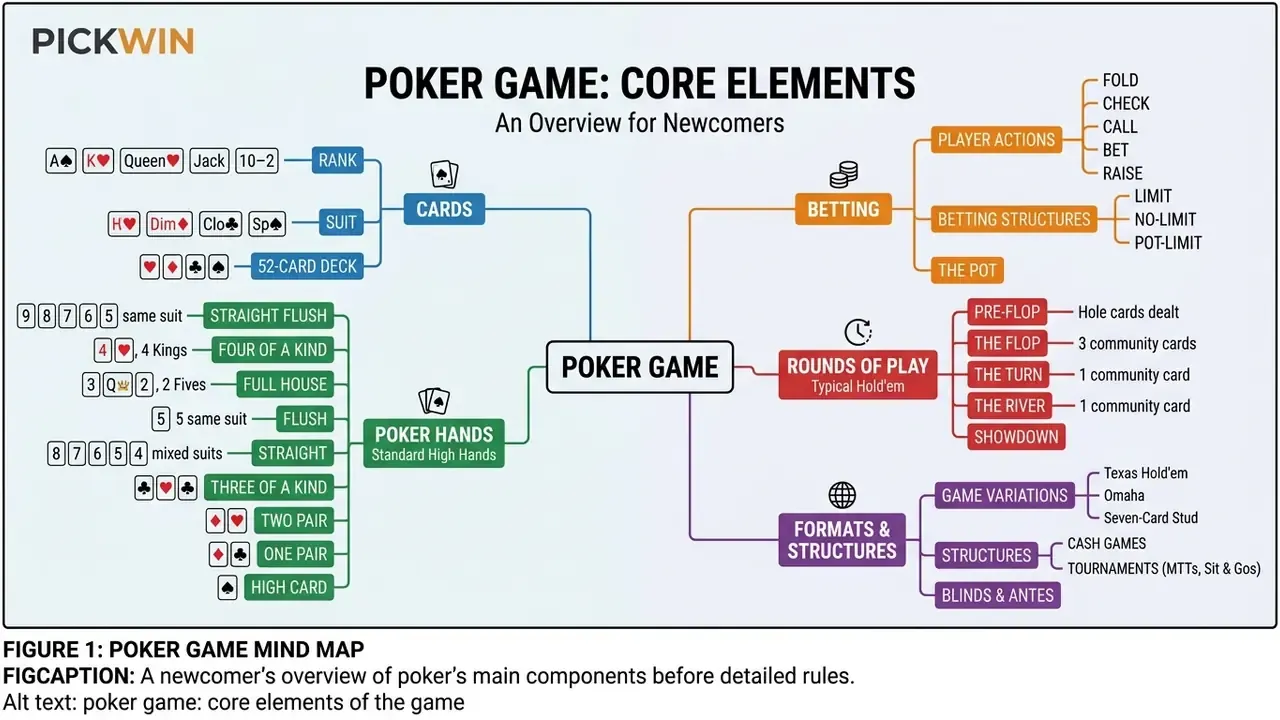
Text version of the mind map:
- Basic rules: the goal is to win the pot; the ways to win are the best hand at showdown or a fold from every opponent.
- Hole cards and community cards: card hands (2 hole cards in Hold'em) plus community cards (5 shared cards across flop, turn and river).
- Bets and rounds: forced blinds (or antes), pre-flop, flop, turn, river, showdown.
- Formats: Texas Hold'em, Omaha, Stud, Short Deck (in No-Limit, Pot-Limit and Fixed-Limit structures).
- Online modes: Demo (risk-free practice), Real Money (CAD, Interac, limits), Live Dealer (a real host on a live stream).
Basic poker rules: cards, hands and the winner of the pot
Basic poker rules state that the strength of any player's hand is determined strictly by the best five-card combination assembled according to the standard hierarchy. No sixth or seventh card counts, except when kickers (high cards) are compared after the main combination ties.
Traditional poker uses a standard 52-card deck of four suits (spades, hearts, diamonds, clubs) without jokers. All suits are equal: no suit outranks another when deciding a hand. The winner is the player whose card hands form the rarest and highest-ranking combination once the final betting round closes.
Poker hands: how card hands are compared
The poker hand hierarchy contains ten classic categories, listed here from strongest to weakest.
- Royal Flush: ten, jack, queen, king and ace of the same suit. The highest hand in the game.
- Straight Flush: five consecutive cards of one suit (for example 9♠ 8♠ 7♠ 6♠ 5♠).
- Four of a Kind / Quads: four cards of the same rank plus one side card (for example J♥ J♦ J♣ J♠ 5♦).
- Full House: three cards of one rank plus a pair of another rank (for example K♠ K♥ K♦ 8♣ 8♥). Such a hand is described as "kings full of eights".
- Flush: any five cards of one suit that are not in sequence (for example A♦ J♦ 8♦ 4♦ 3♦).
- Straight: five cards of consecutive ranks in mixed suits (for example 10♥ 9♣ 8♠ 7♦ 6♥). The ace can serve as the highest card (A-K-Q-J-10) or as a one in the lowest straight (5-4-3-2-A, known as the "wheel").
- Three of a Kind / Set / Trips: three cards of the same rank plus two unrelated cards (for example 7♦ 7♠ 7♣ Q♥ 2♠).
- Two Pair: two cards of one rank, two of another rank and one kicker (for example Q♠ Q♦ 9♥ 9♣ K♠).
- One Pair: two cards of the same rank plus three side cards (for example A♥ 10♦ 10♠ 8♣ 3♥).
- High Card: five cards that make none of the above. Hand strength is then decided by the highest card.
If several players hold the same category of hand (say, one pair each), the higher-ranked pair wins. If the pairs are identical, the kicker rule applies: the remaining highest unpaired cards are compared one by one in descending order. Suits never break the tie, no matter what a home-game friend once told you.
«In a sample of 4.45 million online decisions, players systematically overvalued weak ace-high hands, making unprofitable calls against opponents holding made pairs.» — Dertwinkel-Kalt, Kasinger & Schneider, Games and Economic Behavior (2024). https://doi.org/10.1016/j.geb.2024.01.002
Special hand variations (Wild Cards): some home games and video poker formats use jokers or "wild cards", for example all deuces or one-eyed jacks, usually at the dealer's choice. When wild cards are in play, an extra top category joins the hierarchy: Five of a Kind, four cards of one rank plus a wild card (for example Q-Q-Q-Q plus joker). A wild-card hand is conventionally ranked below a natural hand of the same nominal value, and this should be agreed before the game starts. Classic Texas Hold'em and Omaha use neither jokers nor wild cards.
How many cards players receive and which cards are community cards
In Texas Hold'em, the most popular format, each participant is dealt two cards face down (hole cards) that only they can see. Over three subsequent stages, the dealer places five face-up community cards on the table:
- Flop:the first three community cards, revealed simultaneously.
- Turn:the fourth community card (also called "fourth street"); it opens the third betting round.
- River:the fifth and final community card.
Before each of these stages the dealer performs a procedural action known as burning a card (burn card): the top card of the deck is discarded face down into the muck. This prevents marked-card manipulation and stops players from reading the next card from accidental defects on the back of the deck. In online rooms the same rule is reproduced by the software, and in live dealer studios you will physically see the dealer burn a card before the flop, the turn and the river.
Each player builds their final poker hand by choosing any five cards out of the seven available: two hole cards plus five community cards. You may use both hole cards, only one of them, or none at all if the best hand is already on the board. That last case is called playing the board, and it usually ends in a split pot.
Under Canadian online poker rules, determining the winner is automated: the software instantly reads the five-card hands and splits the pot evenly if the players remaining at showdown hold identical hands all the way down to the last kicker. No arguing with the dealer, which is one small mercy of the digital table.
Classic poker hand rankings (poker hands ranking)
| Hand name | Composition of five cards | Tie-break rule |
|---|---|---|
| Royal Flush | 10, J, Q, K, A of one suit | Split pot (hands are absolutely equal). |
| Straight Flush | Five consecutive cards of one suit | The highest card in the sequence wins. |
| Four of a Kind | Four cards of one rank plus one kicker | Rank of the quads first, then the kicker. |
| Full House | Three of one rank plus two of another | Rank of the trips first, then the rank of the pair. |
| Flush | Five cards of one suit in any order | Highest card, then second, third, fourth and fifth in descending order. |
| Straight | Five consecutive cards of mixed suits | The highest card of the run wins. |
| Three of a Kind | Three cards of one rank plus two kickers | Rank of the trips, then the higher kicker. |
| Two Pair | Two of one rank, two of another, one kicker | Top pair, then bottom pair, then the kicker. |
| One Pair | Two cards of one rank plus three kickers | Rank of the pair, then kickers in turn. |
| High Card | Five cards making no combination | Highest card, then the next ones in descending order. |
How a betting round works in poker
A betting round in poker is a strictly regulated circle of wagering in which players act in turn and set the price of staying in the hand. A Texas Hold'em deal contains four consecutive betting rounds: pre-flop, flop, turn and river.
A betting round is only complete when every active player has put the same amount into the pot or has folded. If one participant raises, the order of action continues until the remaining players call, re-raise, or fold in response to that last bet.
«Playing several tables at once increases cognitive load and, according to account-based models, correlates with elevated problem gambling risk.» — Systematic review of online gambling, Journal of Gambling Studies (2024). https://pmc.ncbi.nlm.nih.gov/articles/PMC10280123/
For beginners the practical conclusion is simple: master one table before adding a second one. Multi-tabling multiplies hands per hour, but it also multiplies the number of decisions you make on autopilot.
Order of action: when it is your turn to bet
The order of action at the table is anchored to the nominal dealer position, the button (BTN). The button moves one seat clockwise after every completed hand.
- Forced bets, blinds:before the cards are dealt, the two players to the left of the button post the small blind (SB) and the big blind (BB). These compulsory contributions guarantee there is always something to fight for. A player joining a game in progress must post a big blind, and most rooms allow this from any position.
- Forced bets, ante:an ante is a small mandatory bet of equal size posted by every player at the table before the cards are dealt. Unlike blinds, antes are used in tournament structures (often alongside blinds in later levels) and in Stud disciplines to stimulate action at the table. Most non-Hold'em variants historically use an "ante up" system rather than blinds.
- Pre-flop:the first turn to bet belongs to the player seated to the left of the big blind (position Under the Gun, UTG). The options are fold, call (match the BB) or raise. Action continues clockwise and, provided there are no subsequent raises, closes on the big blind, who has the option to check the action closed or raise. If a raise is made, action continues until every remaining player has responded to that raise, so the last decision belongs to the final player facing the outstanding bet, not automatically to the BB.
- Post-flop (flop, turn, river):the order changes. The first active player to the left of the button, usually the SB or BB, always acts first. The button and other late positions gain an advantage: they decide last, with full information about their opponents' actions.
Actions available on your turn to bet:
- Check: pass the action to the next player without adding money to the pot (available only when no bet has been made in the current round).
- Bet: the first wager in the current betting round.
- Call: match the bet made before you. To call, you must add enough chips to equal everything the other players have bet since your last action.
- Raise (also "bump"): increase the size of the current bet. You cannot raise above the maximum allowed by the game's structure.
- Fold: discard your hand and give up any claim to the pot. Online, your cards vanish; live, you place them face down in front of the dealer so as not to expose information.
After the last bet: showdown and awarding the pot
When the final betting round on the river closes, the hand is finalised. If any bet or raise (the last bet) is met with folds from everyone else, the single remaining player takes the pot without showing their cards.
If two or more players are still in the hand after river betting closes, the showdown takes place. Players reveal their hole cards in the order set by the software or house rules, usually the player who made the last bet or raise on the river shows first. The software compares the five-card hands, identifies the strongest, and transfers the pot to the winner's balance.
Complex situations: all-in, side pot and check-raise
Non-standard mathematical and procedural situations occur constantly, and they follow a clear protocol:
- All-in and side pot:if a player runs out of chips during a betting round, they do not have to fold. They go all-in with everything left in front of them. That player can only win the portion of the pot they contributed to (the main pot). Any further betting by the remaining participants forms a side pot, which the all-in player cannot claim. Multiple all-ins with different stack sizes create several layered side pots, each awarded separately at showdown.
- Check-raise:a strategic move where a player first checks on their turn to bet, invites an opponent to bet, and then answers with a large raise. It is one of the strongest ways to build a pot with a made hand out of position, and one of the most common traps for beginners who bet automatically after a check.
- Cards speak:in live poker and official tournaments, the final value of a hand is determined solely by the physical cards shown at showdown, regardless of what the player announced verbally. If you declare "two pair" and the dealer turns over a straight, the visible hand stands. Online, the software applies the same principle automatically.
- Split pot / tied hands:when the best five-card hands are identical (suits do not matter), the pot is divided evenly between the players concerned. Odd chips are usually awarded to the first eligible seat left of the button, per house rules.
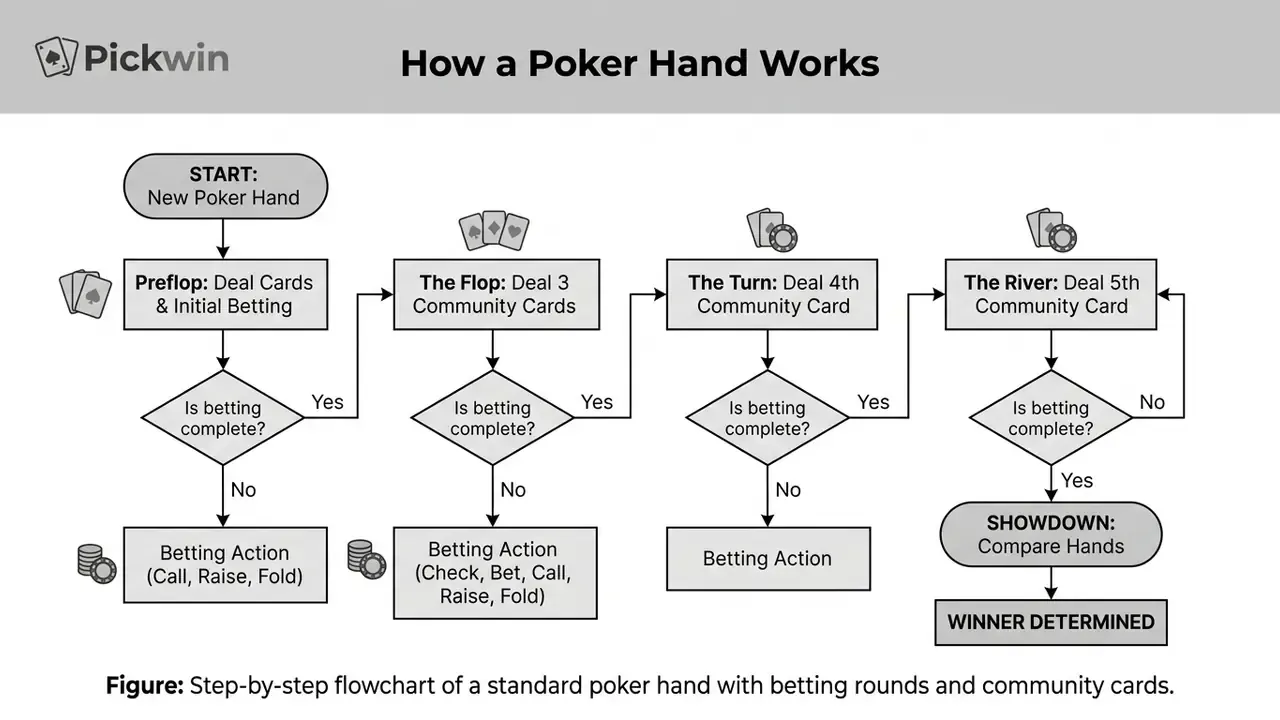
Text alternative to the flowchart:
- Start of the hand: forced small blind and big blind are posted (in tournaments, antes as well).
- Deal: each player receives two hole cards face down.
- Pre-flop (betting round 1): action begins UTG. Options: fold / call / raise / all-in.
- Flop: the dealer burns one card and reveals three community cards. Betting round 2: action starts with the first active player left of the button. Options: check / bet / call / raise / fold / all-in.
- Turn: burn one card, reveal the fourth community card. Betting round 3: the same circle of betting.
- River: burn one card, reveal the fifth community card. Betting round 4 (last bet): the final circle of betting.
- Finish: everyone folded, so the winner takes the pot without showing. Two or more players remain, so it goes to showdown (hands are compared, main pot and any side pots are awarded).
Poker demo, poker real money and poker live dealer: which mode to choose
The modern poker online segment offers three main formats, each solving a specific user task depending on experience, goals and willingness to take financial risk. Choosing between demo, real money and live dealer poker comes down to whether you want to learn the software with no outlay, compete against real opponents for money, or enjoy the atmosphere of a physical venue with a live host.
Poker demo: learning the rules without playing for money
Poker demo is a free practice mode played with virtual chips (play money). It is ideal for users meeting the discipline for the first time who want to learn the basic poker rules without a cent of financial risk.
In demo mode you can calmly:
- master the software mechanics: deal buttons, bet-size sliders, the time bank;
- practise instant recognition of poker hands and their hierarchy;
- understand how positions rotate and how betting rounds progress.
«In a Canadian cohort of 1,220 young people who had never gambled for money, migration was recorded specifically from simulated poker to real-money poker — but not to other forms of gambling.» — Thorne et al., PMC / Journal of Gambling Studies (2023). https://pmc.ncbi.nlm.nih.gov/articles/PMC10280123/
The same body of research supports a second caveat: demo play is stripped of the emotional pressure of real money (loss aversion). Because opponents in demo risk nothing, their behaviour differs radically from real games. They make absurd calls and reckless bluffs, which makes free tables unsuitable for practising serious mathematical strategy. Use demo for mechanics and rule recognition, not for stake psychology or money management.
Poker live dealer and live casino: how the format differs
Live dealer poker and poker live casino formats combine the online platform with the physical gambling house. A professional human dealer runs the deal from a purpose-built studio and the feed is streamed in high quality in real time.
Key differences from a traditional random number generator (RNG) game:
- Transparency:cards are dealt by hand from a physical deck or shoe using barcode scanners, so no algorithmic RNG determines the outcome.
- Pace:dealing speed in a live casino is slower than at software tables, because the dealer needs time to physically collect and shuffle the cards.
- Game types:in poker casino sections, the game is often presented as a "house" format (Casino Hold'em, Ultimate Texas Hold'em, Three Card Poker), where you compete not against other players but directly against the dealer. Note that some operators classify these products under live casino rather than poker. The math is different too: no rake, but a built-in house edge instead of beatable opponents.
Comparison of online poker modes
| Comparison criterion | Poker Demo (play money) | Poker Real Money (P2P) | Poker Live Dealer / Live Casino |
|---|---|---|---|
| Financial risk | None (0 CAD) | Depends on the limit (real bankroll) | Fixed risk per bet (real bankroll) |
| Main purpose | Learning rules and the software interface | Competition against other players for CAD | Casino atmosphere, entertainment with a dealer |
| Opponents | Play-money participants / bots | Real players (P2P) from around the world | The house dealer |
| Hand speed | High (up to 80–100 hands/hour) | Very high (200+ hands/hour on fast-fold) | Moderate (30–50 hands/hour due to manual dealing) |
| Preparation required | Minimal (basic knowledge) | High (strategy, bankroll management) | Medium (knowing the rules of the specific table) |
Which mode should you pick right now?
- Never played a hand: start in demo, play 20 to 30 hands, and only move on once you can name every hand instantly.
- Know the rules and want a real test of skill: choose real money micro-stakes (NL2) or freerolls, where opponents behave rationally and strategy actually pays.
- Want the casino feel with simple rules: choose live dealer, but remember you are facing a fixed house edge rather than beatable opponents.
«In 2024, players in the United States spent between $8.5bn and $10.6bn on Gold Coin packages at sweepstakes casinos; operators retained roughly $3.4bn in net revenue after prizes.» — Responsible Gambling Council, sweepstakes casino market report (2024–2025). https://pmc.ncbi.nlm.nih.gov/articles/PMC10280123/
That figure is a useful reality check: "free-to-play" poker and sweepstakes formats are monetised at industrial scale, even when no traditional deposit is involved.
Disclaimer: this information is general in nature and does not replace advice from a qualified professional. Playing for real money involves the risk of financial loss.
Legal note / Responsible Gambling disclaimer (19+): Access to real-money poker and live casino products is permitted strictly for those of legal age (19+ in most Canadian provinces; 18+ in Alberta, Manitoba and Quebec). Gambling for money carries the risk of financial loss and is not a way to earn income or invest. Never play with money you cannot afford to lose. At the first signs of dependency, use self-exclusion tools or seek free help from Canadian support resources: ConnexOntario or your provincial problem gambling helpline.
Poker strategy for beginners: how to make decisions at the table
Basic poker strategy is about making decisions with positive expected value (+EV) systematically and minimising expensive mistakes over distance. A beginner must understand that no strategy guarantees a win in any single hand, because of variance, the short-term volatility of results.
The pillars of a beginner strategy are a disciplined starting-hand selection (the widely taught tight-aggressive style), respect for positional advantage, fundamental pot-odds arithmetic, and strict bankroll management. Note the evidence status here: tight-aggressive play is the consensus recommendation of coaches and training platforms rather than a conclusion of a peer-reviewed trial; the academic literature supports the broader claim that skilled decision-making produces measurable long-run differences in returns (Games and Economic Behavior, 2024, https://doi.org/10.1016/j.geb.2024.01.002), not any single style label.
Evaluating poker hands before deciding on a bet
Assessing the strength of your card hands begins before any community card is dealt. Starting hands are classified into categories: premium pairs (A-A, K-K, Q-Q, where a pair of aces is nicknamed bullets), strong suited broadway hands (A-K, A-Q, K-Q), suited connectors (9-8, 8-7) and small pocket pairs.
When deciding whether you need to bet in a betting round, weigh:
- Absolute hand strength:do you have a made hand (a set, two pair) or only potential to improve, that is a draw, such as a flush draw or a straight draw?
- Relative hand strength:how does your hand look against the specific board texture? Pocket aces are enormously strong on a dry board (K♦ 7♠ 2♣) but lose much of their value on a coordinated board (10♥ 9♥ 8♥), where opponents can easily hold made straights or flushes.
- Pot odds and outs:count the cards left in the deck (outs) that complete a winning hand. Using the "rule of four and two", multiply your outs by four on the flop or by two on the turn to approximate the percentage chance of getting there.
If the price you are being asked to pay exceeds the equity your hand holds, the only correct move is to fold. Simple to say, harder to do at 1 a.m.
«Among experienced but unprofitable players, the preference for 'lottery-like' situations with a small chance of a large win is strongest — even when probabilities are transparent.» — Dertwinkel-Kalt, Kasinger & Schneider, Games and Economic Behavior (2024). https://doi.org/10.1016/j.geb.2024.01.002
In other words, the temptation to chase a long shot does not disappear with experience. It has to be replaced by a rule you follow mechanically, which is what the following decision map is for.
Player cheat sheet: basic flop scenarios (flop action tree)
- You hold a strong made hand (a set, two pair, top pair with a strong kicker):
- Action: bet / raise.
- Goal: grow the pot with a value bet and make drawing hands pay a price to continue.
- You hold a draw (four cards to a flush or a straight):
- Action: call if the pot odds exceed the probability of completing the draw, or semi-bluff raise to seize the initiative and add fold equity.
- The board missed your hole cards completely (no pair, no draw):
- Action: check / fold. Do not put money into the pot with a hand that cannot win and cannot improve. If the flop comes and your hand does not play, checking and folding costs you nothing beyond the chips already committed.
- You hold a marginal hand (middle pair, weak top pair on a wet board):
- Action: prefer check / call one street over building a big pot; re-evaluate on the turn.

How other players' actions influence your strategy
Poker is a game of incomplete information, in which the actions of others are your main source of data about their cards. The size and character of opponents' bets directly change the equity you need to continue.
If an opponent makes an oversized bet, larger than the pot, they are forcing you to weigh risk against reward under a worse price. Constantly calling passively against aggressive raises is a reliable route to steady losses. Conversely, a re-raise (3-bet) strategy lets you seize the initiative and push opponents into mistakes. In multiway pots, each extra active opponent increases uncertainty and reduces the value of marginal hands, so fold, call and raise thresholds must be recalibrated against several ranges at once.

«Experienced players show higher adaptability to changing conditions and faster recalibration of decisions when aggression at the table shifts, compared with novices.» — Giustiniani et al., Addiction Biology (2024), EEG + IGT study, n=42. https://doi.org/10.1111/adb.13380
Beginners are advised to avoid complex bluffs in multiway pots and to concentrate on making straightforward value bets with strong hands. Boring, and profitable.
E-E-A-T fact check / verification: Misconception: "Using correct poker strategy guarantees a profit in every session." Fact: poker strategy manages probabilities and maximises long-run expected value (+EV). Within a single hand or a short session, random card distribution can hand the win to a mathematically illiterate player. Over tens of thousands of hands, however, the laws of probability erode luck and push players with sound strategy into profit. Correct decisions can lose the pot and still be +EV.
Poker bonuses, rake and rakeback: how not to fall into a T&C trap
Poker economics differ from slots economics, and so do poker promotions. Understanding this block is what separates a break-even grinder from a losing one.
Rake is the operator's commission. In cash games it is normally a percentage of each pot, often around 3 to 5%, with a per-hand cap; in tournaments it is a fee built into the buy-in (for example a $10 + $1 structure, where $1 is the rake). Rake is charged whether you win or lose the hand, which is why high-volume play at limits above your skill level is expensive by default.
Rakeback and loyalty programs return a share of the rake you generate, either as a fixed percentage, as points exchanged for cash, or as tiered weekly missions. For a micro-stakes player, rakeback is often the difference between a small loss and a small profit.
Poker bonus vs casino bonus, the key difference:
| Parameter | Casino welcome bonus | Poker first-deposit bonus |
|---|---|---|
| How it is released | Wagering the bonus amount a set number of times on games | Released in instalments as you generate rake or earn loyalty points |
| Typical mechanics | "Wager 35× bonus within 30 days" | "Receive $10 for every $50 of rake generated, up to $500" |
| Time pressure | Days to weeks | Often 30 to 90 days per instalment tranche |
| Main risk | Max bet limits and excluded games void the bonus | You never generate enough rake at micro-stakes to unlock the full amount |
Traps to check before opting in:
- Max cashout on the bonus or on the winnings derived from it.
- Expiry of unreleased instalments. Unclaimed chunks usually disappear rather than roll over.
- Whether tournament fees count toward the rake requirement (sometimes only cash-game rake qualifies).
- Whether the bonus blocks withdrawals while it is active. Some rooms lock the balance until the bonus is cleared or forfeited.
- Currency conversion. A bonus advertised in USD credited to a CAD account can shrink on conversion.
Practical rule: at NL2, generating $500 of rake takes an enormous number of hands. Estimate how much rake you realistically produce per month, then judge whether a headline "$1,000 bonus" is worth anything to you at all. A modest bonus with a low rake requirement usually beats a large one you can never clear. Our comparisons of Canadian operators and their promotional terms are published on the iGaming reviews hub.
How to start playing poker online in Canada
Starting to play poker online requires several mandatory organisational steps that protect your data and your money. Before your first bet, make sure the operator holds a valid licence from the relevant regulator and supports convenient Canadian payment rails such as Interac e-Transfer.
Legality by province: what actually differs
- Ontario: a fully regulated commercial market. Operators are registered with the AGCO and hold agreements with iGaming Ontario; player funds, advertising standards and dispute resolution are covered by provincial rules. Ontario players generally sit in a ring-fenced player pool, which can mean smaller traffic but a clear legal status.
- Quebec, British Columbia, Alberta, Manitoba, the Atlantic provinces: provincial lottery corporations run their own legal platforms, while many residents also play at internationally licensed rooms, for example under Malta Gaming Authority or Kahnawake licences. This is the widely described "grey" area: playing is not prosecuted at the individual level, but you rely on the offshore regulator rather than a provincial one for protection.
- Age: 19+ in most provinces, 18+ in Alberta, Manitoba and Quebec.
Disclaimer: this section is general information, not legal advice. Gambling regulation changes frequently and differs by province. Verify the current status with your provincial regulator before depositing.
Typical CAD withdrawal speeds at Canadian-facing poker rooms
| Method | Typical processing time | Notes |
|---|---|---|
| Interac e-Transfer | 1–24 hours | Fastest mainstream CAD option; requires completed KYC. |
| E-wallets (Skrill, MuchBetter, PayPal where available) | Up to 24 hours | Often the same-day option; watch currency conversion fees. |
| Visa / Mastercard | 1–3 business days | Bank posting time adds to operator processing time. |
| Cryptocurrency | Up to 1 hour | Network fees and volatility apply; not offered by all licensed rooms. |
| Bank / wire transfer | 2–5 business days | Usually reserved for large withdrawals. |
All timings are typical ranges observed across Canadian-facing operators; first withdrawals are slower because documents must be reviewed.
Sign up and choosing a mode for your first poker game
For a safe start, follow this step-by-step algorithm:
- Choose a licensed platform. Check the licence details in the site footer, confirm that accounts can be held in Canadian dollars (CAD), and verify SSL encryption. Our vetted shortlist of licensed platforms is a practical starting point.
- Register (sign up). Complete the form with accurate personal data: name, date of birth, Canadian address, e-mail. Mistakes here lead to a frozen account at withdrawal time.
- Verify the account (KYC). Upload an identity document (passport or driver's licence) and proof of address, such as a utility bill. Do this before you win, not after.
- Start in the training mode (poker demo). Open the "Play Money" or "Demo" tab and play 20 to 30 hands to get used to the timer speed and the control buttons.
- Make your first deposit (for real money or live dealer). Go to the Cashier, choose Interac or a bank card, and set daily deposit limits before confirming the transaction.
- Choose a starting table. Real-money beginners should pick micro-stakes (NL2 with $0.01/$0.02 CAD blinds, and note the buy-in, the minimum amount required to sit down) or tournaments with a minimal fee, such as freerolls and micro buy-ins.
«A systematic review of 42 studies identified male gender, young age and high session frequency as the most consistent predictors of problem online gambling.» — Systematic review, Journal of Gambling Studies (2024). https://pmc.ncbi.nlm.nih.gov/articles/PMC10280123/
Disclaimer: this information is general in nature and does not replace advice from a qualified professional. Make sure the operator you choose is licensed in your province.
Checklist: four checks before your first CAD deposit
- Licence. A named regulator (AGCO/iGaming Ontario, MGA, Kahnawake) with a verifiable licence number in the footer.
- CAD support. The account, tables and cashier work in Canadian dollars, with no hidden conversion on deposit or withdrawal.
- Interac available for withdrawals, not only for deposits. Check the cashier's payout list, not the marketing page.
- KYC completed and limits set. Documents approved, deposit and session limits configured, self-exclusion tools located.
How we test poker rooms
Our assessments are hands-on rather than desk-based. For each room in our Canadian sample we open a standard account, deposit CAD via Interac, complete the KYC process from scratch, play a minimum block of hands across micro-stakes cash tables and at least one tournament, then request a withdrawal and record the exact time to receipt. We log rake charged per pot, bonus release increments, support response times and any friction during verification. Where an operator refuses or delays a payout, we document the correspondence. This methodology is why our observations about beginner losses and payout speeds come from measured sessions rather than press releases.
Approaching the process deliberately protects your bankroll and gives you real control over the game. Poker is a discipline that combines mathematical rigour with strategic calculation, and over distance discipline always proves more valuable than momentary risk-taking.

FAQ
What happens if two players both have two pair?
Compare the higher pair first. If those are identical, compare the lower pair. If both pairs match, the fifth card, the kicker, decides. If everything matches, the pot is split. Remember that suits never break a tie.
Are poker winnings taxed in Canada?
For recreational players, gambling winnings, poker included, are generally not treated as taxable income in Canada, because they are considered windfalls rather than business income. Players whose poker activity resembles a business (systematic, professional, expectation-of-profit play) may be assessed differently, and interest earned on winnings can be taxable. This is general information, not tax advice; consult a Canadian tax professional about your situation.
Is online poker legal where I live?
Legality is province-specific. Ontario has a licensed commercial market under the AGCO and iGaming Ontario; other provinces operate lottery-corporation platforms while residents also use internationally licensed rooms. Always confirm the current rules for your province and never play if you are under the legal age (19+ in most provinces, 18+ in Alberta, Manitoba and Quebec).
How big should my starting bankroll be?
Standard guidance for cash games is a minimum of 30 to 50 buy-ins for the limit you play, and 100+ buy-ins for tournaments, precisely because of variance. At NL2 that is a modest sum in CAD, which is exactly why micro-stakes exist.
Is playing demo poker useful practice?
Yes, for mechanics: interface, timers, bet sliders, hand recognition. No, for psychology and strategy. Opponents risking nothing behave nothing like opponents risking money, and the research on player trajectories shows demo play is itself a documented pathway into real-money poker, so treat it as a short bridge rather than a permanent home.
Does rake really matter at micro-stakes?
It matters enormously. Rake is deducted from pots you win, so it directly compresses your win rate. At the lowest limits, rake plus a weak rakeback deal can turn a marginally winning strategy into a losing one.
What should I do if several players go all-in with different stacks?
The dealer or software builds a main pot and one or more side pots. Each player can win only the pots they contributed to. At showdown, the side pot is awarded first among eligible players, then the main pot.
Poker glossary
- All-in —committing every chip you have left; you remain eligible for the main pot but not for any side pot formed afterwards.
- Ante —a small forced bet posted by every player before the deal, common in tournaments and Stud games.
- Big Blind (BB) —a designated forced bet posted by the player two seats clockwise from the button before any cards are dealt.
- Bullets —a pair of aces.
- Bump —slang for "to raise".
- Burn card —the top card discarded face down before the flop, turn and river to prevent card-reading and manipulation.
- Buy-In —the minimum amount required to sit down at a given cash table or to enter a tournament.
- Cards Speak —the rule that the physical cards shown at showdown determine hand value, regardless of what was declared verbally.
- Check-Raise —checking first in a betting round, then raising after an opponent bets.
- Downcard (hole card) —a card dealt face down, visible only to its owner.
- Natural hand —a hand containing no wild cards.
- Rake —the operator's commission taken from each pot or built into a tournament fee.
- Rakeback —a loyalty mechanism returning part of the rake you have generated.
- Rank —the value of a card, from deuce up to ace.
- Showdown —the revealing of hands after the final betting round to determine the winner.
- Side pot —a separate pot created by bets made after a player is already all-in; that player cannot win it.
- Tilt —emotionally driven, mathematically poor play following a loss or a bad beat.
- Turn —in flop games, the fourth community card; it opens the third betting round.
- Upcard —a card dealt face up, its value visible to everyone at the table.
- Wild card —a card that can take any rank or suit at the holder's discretion in certain home and video poker games; enables Five of a Kind.
- WSOP —World Series of Poker.

What to do next
- Memorise the hand rankings table above until you can name any hand in under two seconds.
- Play 20 to 30 demo hands to learn the interface and the timer.
- Run the four-point safety checklist, set deposit limits, and only then move to NL2 or a freeroll.
- Track your rake and your rakeback from your first session. Poker profit is built at the margins.
Responsible gambling reminder (19+ / 18+ depending on province): gambling must remain entertainment, never a source of income. Set deposit, loss and session limits before you play, use self-exclusion tools if you need them, and contact ConnexOntario or your provincial support service for free, confidential help. This article is general information about game rules and formats and does not constitute legal, tax or financial advice.