Table of Content

Plinko Online: How to Play Free, in Demo, and for Real Money

Last updated: January 2026 | Reviewed for Canadian players (19+ / 18+ in AB, MB, QC)

Plinko is an online arcade-style casino game built on the mechanics of the Galton board. A ball drops, bounces down a grid of pegs, and lands in a pocket carrying a payout multiplier. That is the whole game. Whether you play for fun in demo mode or stake real Canadian dollars, the useful knowledge sits in three places: board configuration, risk levels, and how the random number generator settles each round.

«When reviewing digital casino mechanics, player clarity comes before marketing claims. Plinko runs on transparent mathematical models, but you need to understand how rows, risk settings, and the house edge interact before depositing a single dollar.» — Reid Calloway, Independent Casino Analyst (editorial persona).

Provider

BGaming

RTP

99.00%

Volatility

Medium

Min bet

$1.00

Max bet

$100.00

Max win

x1000

Plinko Online How to Play Free

The Main Points in 30 Seconds

  • Mechanics:Every peg contact is an independent 50/50 binary deflection. Outcomes follow the binomial distribution $P(k) = \binom{n}{k}(0.5)^n$, so central pockets are hit far more often than edges.
  • Best RTP on the market:BGaming's original Plinko publishes a theoretical RTP of 99.00%. Most competing releases (Spribe, Hacksaw Gaming, Print Studios) sit between 96.00% and 97.00%.
  • Demo vs real money:Demo credits reproduce identical board physics but hold zero cash value and cannot be withdrawn. Real money mode requires KYC verification and exposes your bankroll on every drop.
  • Rows and risk change volatility, not RTP:8 rows means 7 to 8 peg deflections and tight outcomes; 16 rows means 15 to 16 deflections and extreme dispersion. Risk tiers redistribute payout weight without altering long-run return.
  • Drop position is cosmetic:In Provably Fair casino Plinko, the landing pocket is cryptographically fixed before the animation renders. Left, centre, or right release points have 0.00% statistical effect.
  • No system beats the house edge:Martingale and other progressive schemes change variance only. Bankroll limits, small stakes, and stop-loss rules are the only genuine controls.
  • Canada specifics:Ontario players can use iGaming Ontario/AGCO-licensed operators; other provinces rely on provincial monopolies or offshore-licensed sites. Interac e-Transfer in CAD is the standard payment rail.
  • Bonus warning:Arcade and crash-style titles like Plinko frequently contribute 0 to 10% toward wagering requirements, and max-bet caps often apply while a bonus is active.
The Main Points in 30 Seconds

Why This Matters Before Your First Deposit

Here is what usually goes wrong. A player finds Plinko in a lobby, likes the animation, deposits CAD $50 on the back of a "100% match" banner, then discovers two weeks later that arcade titles counted 10% toward the wagering requirement. The board math was never the problem. The terms were.

So this guide takes the order that actually protects you: mechanics first, then Canadian legal and payment context, then the brand and bonus checks, then the limits of strategy. Read the risk section even if you skip the maths.

Historical Context: From Television Game Show to Digital iGaming

Long before it reached crypto casinos, Plinko was invented by executive producer Frank Wayne and introduced on the American television game show The Price Is Right in January 1983. Bob Barker, who fronted the show from 1972 until 2007 before Drew Carey took over, watched contestants drop physical plastic discs down a wooden pegboard for cash prizes. The Price Is Right first aired in 1956 and remains the longest-running game show in television history, with Plinko standing as its single most recognisable pricing game.

The format also shares visual DNA with Japanese pachinko parlours, where steel balls cascade through dense pin fields. Modern digital Plinko replaces physical gravity with binary deflection algorithms and Provably Fair random number generators, while keeping the classic triangular pyramid, adjustable row counts, and multiplier pockets that grow richer toward the outer edges.

Historical Context From Television Game Show

What Is Plinko Game and How Does the Game Work

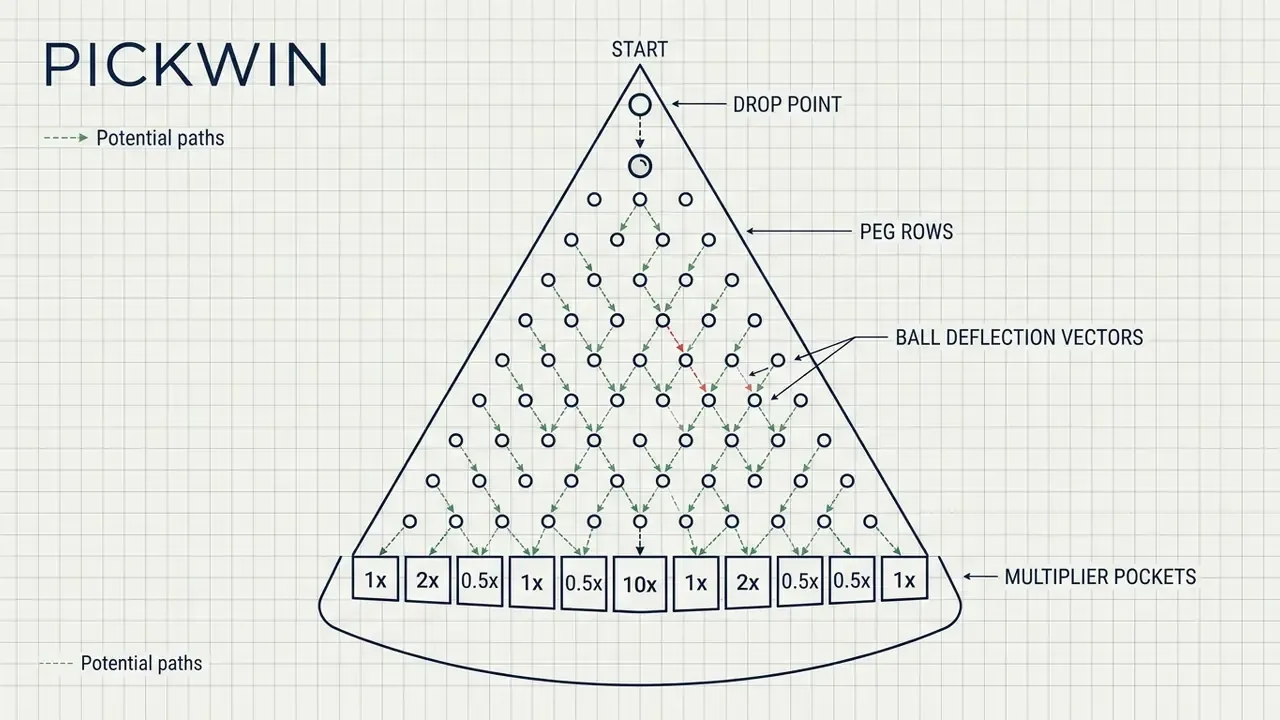
Plinko is a digital casino game where a virtual ball drops from the top of a triangular pyramid of pegs, deflecting randomly until it lands in a multiplier slot at the bottom. Each round is settled by a certified Random Number Generator (RNG) or a Provably Fair cryptographic algorithm, which means every drop is statistically independent of the one before it.

plinko game: pegs, ball and multiplier breakdown

Field, Ball, and Pegs: The Path of the Ball After the Drop

The trajectory of the ball after the drop is a series of independent 50/50 binary deflections as it strikes each peg row on its descent. Modelled on the Galton board, a ball falling through $n$ rows faces $n$ separate left-or-right decisions, generating $2^n$ possible paths: 256 on an 8-row board, 65,536 on a 16-row board. The animation shows dynamic physical bounces, but the final landing pocket is governed by binomial distribution math ($P(k) = \binom{n}{k} (0.5)^n$). Translation for the player: the ball is far more likely to settle near the centre than at either edge.

«The landing slot index equals the number of right-hand deflections across n rows, giving each slot a probability of C(n,k)·(0.5)^n.» — JetX, Mathematical Analysis of Plinko (2023–2026). https://jetx.com

Because every peg contact is an independent Bernoulli trial with $p = 0.5$, the resulting histogram is symmetrical around $n/2$, and its standard deviation grows only as $\sqrt{n}/2$. The practical consequence is a little counter-intuitive: adding rows widens the range of possible outcomes while making the central pockets relatively more crowded at the same time.

Multiplier and the Result of a Plinko Round

The result of a Plinko round is your stake multiplied by the value printed on the pocket where the ball stops. Central slots carry low multipliers, frequently between $0.2\times$ and $0.9\times$, which returns only part of the bet. Outer slots hold the headline numbers, up to $1,000\times$ or $10,000\times$ depending on the provider.

Independent simulation evidence:

«A 10-million-drop test confirmed an empirical RTP of 97.46% with a 99.99% confidence interval and zero memory effect between rounds.» — BusinessHealth, Plinko Lab Simulation Report (2025). https://businesshealth.com

The "zero memory effect" finding is the part worth remembering. A streak of low central hits does not raise the probability of an edge hit on the next drop. Payout weight is balanced across the board to hold the theoretical RTP target, and every drop resets the distribution from scratch. No warm-up, no pressure building, no due payout.

Not all online Plinko games are identical. Studios differ on maximum payout multipliers, board mechanics, and theoretical Return to Player. Choosing the variant matters far more than choosing a "strategy": the gap between a 96.00% and a 99.00% RTP title is roughly a threefold difference in long-run house edge. Here is how the main releases compare.

How to Play Plinko Online: First Launch

To play Plinko online you pick a stake, configure the board, and release the ball with either manual clicks or an automated round counter. Modern web builds run natively in HTML5 across desktop and mobile, with no extra software to install.

Manual and Automatic Play Mode

Manual play mode triggers one ball at a time, so you can adjust bet size, rows, and risk between rounds. Automatic play mode, or autoplay, runs a preset sequence of drops (commonly 10 to 1,000 rounds) alongside loss limits or profit stop-triggers. The underlying odds and RNG behaviour per ball are identical in both modes.

The real distinction is behavioural, not mathematical. Autoplay compresses dozens of wagers into a minute, and that speed accelerates your exposure to the house edge. If you use it, set a stop-on-loss and a stop-on-profit threshold before the first drop. Do it before, not during. Mid-session willpower is not a limit tool.

Manual and Automatic Play Mode. Manual

How to Start Playing Plinko in a Browser

Playing Plinko online in a browser starts with opening a licensed casino platform, finding the game library, and choosing between demo mode and real-money play. Once the board loads, you set the stake in CAD, choose a row count (typically 8 to 16), pick a risk tier (Low, Medium, or High), and press "Play" or "Drop".

Step-by-step first launch:

  1. Open the casino site in Chrome, Safari, Firefox, or Edge. Plinko ships as responsive HTML5, so no plugin or client install is needed.
  2. Locate Plinko under Originals, Casual, or Arcade in the lobby.
  3. Launch demo mode first to confirm the board loads correctly and to read the multiplier placement.
  4. Set the bet field to the minimum stake while you learn the interface.
  5. Choose rows (start at 8 to 10) and risk (start at Low).
  6. Drop 20 to 30 balls manually and count how often the ball lands in the central sub-$1.0\times$ pockets.
  7. Only then decide whether to switch to real money, and set a deposit limit before you do.
How to Start Playing Plinko in

Plinko Demo and Free Plinko: Practice Without Real Stakes

Plinko demo and free Plinko versions hand you virtual practice credits, so you can test mechanics and volatility settings without spending anything. Demo mode reproduces the same board physics and the same multiplier payouts as the cash version. The difference is simple: those credits cannot be converted or withdrawn.

Feature / ModePlinko DemoFree Plinko (Social)Plinko Real Money
Primary GoalFeature testing & mechanics practiceCasual entertainmentReal money wagering
Balance TypeUnlimited virtual practice creditsPlay-money / social tokensVerified CAD cash balance
Financial RiskZero financial exposureZero financial exposureReal stake exposure per drop
Settings AccessFull access (Rows, Risk, Auto)Full access to board controlsFull access + cash limits
Registration RequiredNo registration required on most sitesOptional account setupMandatory KYC verification (19+)
Withdrawable ValueNoneNone (or sweepstakes-model redemption where legally offered)Yes, subject to T&Cs and KYC

Disclaimer: This information is general in nature and does not replace professional advice. Demo-mode results do not guarantee comparable outcomes in real-money play.

Research on simulated gambling formats adds a caution worth taking seriously before you treat free play as a neutral warm-up:

«Participation in all forms of simulated gambling except free loot boxes was associated with monetary gambling and higher rates of gambling harm.» — Hing et al., Order of First Play in Simulated versus Monetary Gambling (2024). https://hing-et-al-2024.com

Demo games genuinely help with variance, board geometry, and reading how risk tiers reshape the payout ladder. They are a poor predictor of monetary profit, though, and the study above suggests they can work as an on-ramp to cash wagering. So keep practice mode to a narrow technical job: watch how central buckets deliver frequent minor payouts, count how rarely the outer multipliers land, and check that the provider's board behaves the way its paytable claims. If the paytable and the observed spread disagree, that is your answer about the site.

Plinko Real Money and Plinko Casino: What to Consider Before Playing

Plinko real money mode means cash bets and withdrawable winnings, and it also means every drop can take the stake with it. Before moving across from practice play, check three things about the platform: licensing, payment methods (Interac e-Transfer matters most for Canadians), and account security.

Disclaimer & Regulatory Notice: Real money gambling involves significant financial risk and can lead to monetary loss. Plinko is a game of chance based on random number generation; no outcome or payout is ever guaranteed. Online casino games are intended for adult entertainment only (19+ in most Canadian provinces; 18+ in AB/MB/QC). Set strict deposit limits and gamble responsibly. If you or someone you know is experiencing gambling-related harm, free help is available via the Centre for Addiction and Mental Health (CAMH) or your provincial support line.

How Real Money Mode Differs from Plinko Demo

Real money mode needs a funded balance and identity verification (KYC). Demo runs anonymously on simulated credits inside the browser session. In cash play every ball subtracts funds directly from your bankroll, and any pocket above $1.0\times$ returns net profit.

«Roughly 12% of social casino players make a first real purchase, and 52% of those do so within the first 24 hours after registration.» — GrooveTech, Social Casino Conversion Report (2023–2026). https://groovetech.com

That conversion window is the part operators understand better than players do. The move from virtual credits to real CAD often happens on day one, before anyone has set a loss limit. And the psychological gap is the core difference: in demo a $0.2\times$ result is data, in cash mode the same result is a realised loss. That is what fuels chasing.

Canada regulates online gambling province by province, so "is Plinko legal here?" depends entirely on where you live.

  • Ontario: Since April 2022, Ontario has run an open, regulated iGaming market administered by iGaming Ontario (iGO) under the Alcohol and Gaming Commission of Ontario (AGCO). Private operators registered with AGCO may legally offer Plinko to Ontario residents, with mandatory responsible-gambling tooling, dispute resolution, and local RNG certification. Minimum age: 19+.
  • British Columbia, Quebec, Manitoba, Alberta, Atlantic provinces: Provincial Crown corporations (PlayNow, Loto-Québec, PlayAlberta, ALC and others) run the officially sanctioned online platforms. Offshore-licensed casinos (Malta Gaming Authority, Curaçao, Isle of Man) are widely accessed by Canadian players and are not prohibited to the individual player. They do sit outside provincial oversight, which means disputes are resolved under the offshore licence, not Canadian law.
  • Age thresholds: 19+ in Ontario, BC, Saskatchewan, Nova Scotia, New Brunswick, Newfoundland and Labrador, PEI, Yukon, NWT and Nunavut; 18+ in Alberta, Manitoba, and Quebec.
Canadian Legal Status Ontario vs. the

4 Checks Before Depositing CAD: Pre-Deposit Checklist

  • Licence verification. Find the licence issuer, number, and jurisdiction in the site footer, then confirm it on the regulator's public register (AGCO/iGO for Ontario; MGA, Curaçao GCB, or IoM GSC offshore). A badge without a verifiable number is not evidence.
  • Fairness documentation. Confirm the Plinko title publishes either a Provably Fair verification page (server seed, client seed, nonce, hash) or an RNG certificate from an accredited lab such as eCOGRA, iTech Labs, or GLI, with a visible audit date.
  • CAD payments and payout terms. Check that Interac e-Transfer (or Interac Online / Instadebit) is supported in CAD, then read the withdrawal cap, minimum cash-out, monthly limit, and KYC trigger thresholds. Realistic Interac and e-wallet payout speeds run from near-instant to 24 hours after approval; card and bank transfers commonly take 1 to 5 business days. Pending and reversal periods add delay on top.
  • Bonus fine print. Read the game-contribution table, the wagering multiplier, the max bet allowed while a bonus is active, and the maximum cashable amount from bonus funds before you claim anything.
4 Checks Before Depositing CAD Pre-Deposit

How to Evaluate an Offer Before Moving to a Plinko Casino

Before accepting a casino bonus to play Plinko, weigh four operator parameters: valid provincial or international licensing, clear wagering requirements with the game contribution percentage for arcade and crash games, transparent maximum withdrawal limits, and payout speed through reliable local rails like Interac.

How we assess operator compliance: our editorial process for the iGaming review analysis runs a documented, repeatable checklist instead of trusting promotional copy. For each platform we log the licence issuer and number, the publication date of the RNG or Provably Fair documentation, the advertised Interac withdrawal window against the actual terms-and-conditions wording, the deposit and loss-limit tools inside the account area, and the game-weighting table for arcade titles. Where an operator does not publish a required parameter, we mark it not disclosed rather than inferring a value. An absent figure is itself a finding, and a missing game-contribution table is one of the most common gaps we run into. Motto for the method: tested, not told.

How to Evaluate an Offer Before

Bonuses, Wagering, and the Game Contribution Trap

The most expensive misunderstanding in Plinko real-money play is not the board math. It is the bonus terms. Arcade, crash, and "Originals" titles are routinely down-weighted or excluded from wagering, so hours of Plinko drops can clear far less of a bonus than anyone expects.

Bonus TermWhat It Actually MeansTypical Range for Plinko / Arcade Titles
Wagering requirement (WR)Total turnover needed before bonus funds convert to withdrawable cash3× to 45× bonus (or bonus + deposit)
Game contribution / weightingPercentage of each Plinko wager counted toward the WR0% to 10% on many sites; slots usually 100%
Max bet while bonus activeHard cap per drop while wageringOften CAD $5 to $8 per round
Max cashout from bonusCeiling on winnings derived from bonus fundsFrequently 3× to 10× the bonus amount
Bonus expiryDeadline to complete the WR24 hours to 30 days
Excluded games listTitles that count 0% and may void the bonus if playedPlinko, crash games, Dice, live dealer

Practical rule: if the terms say Plinko contributes 10%, a CAD $100 bonus with 30× wagering needs CAD $30,000 of Plinko turnover, not $3,000. And if Plinko sits on the excluded-games list, a single bonus-funded drop can forfeit the whole bonus plus attached winnings. Screenshot the game-weighting table before your first bonus wager. Where arcade titles are down-weighted, plain cash play is usually the cleaner choice.

Rows, Risk, and Multiplier: Plinko Settings That Affect the Game

Changing the number of rows and the risk level reshapes how multipliers are distributed and how volatile the session feels. Neither setting touches the theoretical RTP. Higher row counts and high-risk tiers widen the payout scale, producing bigger peaks alongside thinner central returns.

Rows & Risk SetupPeg DeflectionsVolatility ProfileCentral Slot RangeEdge Slot MultipliersTypical Gameplay Feel
8 Rows, Low Risk7–8 hitsVery Low$0.5\times – 0.9\times$$5.6\times – 10\times$Frequent minor returns, minimal bankroll swings
12 Rows, Medium Risk11–12 hitsMedium$0.4\times – 0.7\times$$33\times – 100\times$Balanced play with moderate multiplier peaks
16 Rows, High Risk15–16 hitsHigh / Extreme$0.2\times – 0.3\times$$555\times – 1,000\times+$Long dry spells broken by rare high-multiplier hits

The peg-deflection column is the mechanical link between the two settings. Each extra row adds one more independent left/right decision, and that is what widens the outcome funnel. Eight rows give a narrow, predictable spread where most balls settle into the same three to five central pockets. Sixteen rows let the ball drift far enough sideways to reach the extreme multipliers, paid for by many more sub-$1.0\times$ landings along the way.

How the Number of Rows Changes the Plinko Game

Going from 8 to 16 rows expands the grid and raises the number of bottom slots from 9 to 17. On a 16-row board the probability of reaching the outermost bucket falls to roughly 1 in 32,768 ($\approx 0.003%$ across both edges combined), while the centre slot collects nearly $19.6%$ of all drops. So more rows make central hits more frequent, which is exactly what lets providers park huge top multipliers on the extreme edges.

«On a 16-row board the central slot captures roughly 19.6% of all drops, while the probability of an extreme edge slot is about 0.0015%.» — Flush, Plinko Provably Fair Documentation (2023–2026). https://flush.com

Both figures describe one distribution from two angles. A single outermost pocket sits at $(0.5)^{16} = 1/65{,}536 \approx 0.0015%$, while the combined chance of hitting either far pocket is $2/65{,}536 = 1/32{,}768 \approx 0.003%$. In practice, at 200 drops per hour of autoplay, you would expect one extreme-edge hit about once every 164 hours of continuous play. Worth sitting with that number for a second.

How Risk Level Affects the Multiplier

Picking Low, Medium, or High risk redistributes payout values across the bottom slots. Low risk keeps central returns close to $1\times$ with modest edge payouts and gentle bankroll swings. High risk pushes central multipliers down to $0.2\times$ or $0.3\times$ and shifts the payout weight into rare outer pockets that can reach $1,000\times$ or more.

«Risk settings change variance, not expected return: every row-and-risk combination in BGaming's Plinko preserves the same 99% RTP.» — Aulegiano, Plinko Guide (2026). https://aulegiano.com

This is the settings-level twin of the drop-position myth. Switching from Low to High does not unlock better value; it converts a shallow, frequent-return experience into a lottery-shaped one, where more than 80% of drops return less than the stake and one edge hit can undo twenty straight losses. High risk plus a high bet size is the fastest route to an empty balance. If you run High risk at 16 rows, cut the stake proportionally.

Plinko Strategy: Can You Increase Control Over the Game?

No betting system alters the random outcome of a Plinko drop or overcomes the fixed house edge. Strategy here is limited to bankroll management, choosing volatility settings that suit your budget, and setting firm session loss limits. That is not nothing, but it is not an edge either.

«Progressive betting systems do not change RTP and can increase the risk of large losses by concentrating stakes into fewer, higher rounds.» — GamblingZone, RTP and House Edge Explainer (2023–2026). https://gamblingzone.com

Fact Check: What Plinko Strategy Can and Cannot Do

  • CAN DO: Adjust session volatility via risk tiers; stretch playing time with smaller bet sizing; set automated stop-loss boundaries; choose a higher-RTP provider version (99% vs 96%).
  • CANNOT DO: Predict ball trajectories; overcome the house edge; force balls into edge slots; guarantee net profit through progressive schemes such as Martingale; identify "hot" or "cold" periods, since results carry zero memory effect.

Choosing Risk, Rows, and Bet for Mindful Gameplay

Mindful Plinko play means matching row count, risk setting, and stake size to an entertainment budget you have already decided on. Conservative sessions work well at 8 to 10 rows on Low or Medium risk with small stakes. High-variance sessions at 16 rows on High risk demand much smaller bets to survive long runs of sub-$1.0\times$ payouts.

A workable frame: treat the session budget as the price of entertainment, divide it by the number of drops you plan to make, and use the result as your bet size. A CAD $50 budget meant to last 500 drops gives a stake of CAD $0.10. Not CAD $2 with a plan to recover later. Then set the autoplay stop-loss at half the session budget, so a bad run ends by rule rather than by mood.

Test any new combination in plinko demo first. Twenty minutes of free play tells you whether a 16-row High risk board matches your tolerance far more honestly than a paytable screenshot does.

Choosing Risk, Rows, and Bet for

Does Drop Position or Timing Affect the Outcome in Plinko?

A common misconception, picked up from casual physics simulators, holds that choosing a drop position (left, right, or centre) can bias the ball toward outer multipliers. In licensed casino games running on Provably Fair algorithms or certified RNGs, the release point is purely cosmetic.

Two entirely different software categories are being confused here:

  • Arcade and social physics simulators run a live physics engine in the browser. The visible trajectory is computed frame by frame from collision geometry, so a different release point really does produce a different visual path. These games pay nothing and are not regulated.
  • Provably Fair or certified-RNG casino Plinko fixes the landing pocket the millisecond you click play. The client seed, server seed, and nonce hash define the winning multiplier before the animation starts. The bouncing ball is a replay of a result that already exists.
Does Drop Position or Timing Affect

«Provably fair systems use SHA-256 with dual seeding: every round's outcome is independently verifiable by any player.» — Flush, Plinko Provably Fair Documentation (2023–2026). https://flush.com

So changing the visual release point on a Provably Fair board has a 0.00% impact on long-term returns or slot probabilities. The same logic kills timing tricks: clicking on a particular second, alternating fast and slow clicks, or "warming up" the board changes nothing, because the seed and nonce pair is the only input to the result. Any guide promising that "edge drops give a better shot at high multipliers" in a real-money product is describing an arcade simulator, not a licensed RNG game. Want to check it yourself? Most Provably Fair platforms let you copy a finished round's server seed, client seed, and nonce into an open-source verifier and reproduce the identical outcome hash.

So changing the visual release point

Plinko Mobile and Plinko Download: Access Options

Plinko is built for mobile and loads straight into a mobile web browser without any dedicated app. The HTML5 architecture reflows the triangular peg board, control panels, and drop button to fit vertical smartphone and tablet screens.

Standalone downloads (APKs or iOS apps) exist on some licensed platforms, but installing one is entirely optional. Browser versions serve identical graphics, identical RTP, and the same security protocols as desktop, across iOS and Android alike.

Three delivery models exist in practice: the responsive web build (Chrome, Safari, Firefox, Edge, no install), the Progressive Web App (PWA), which sits on a home screen and caches for faster launch, and the native wrapper app distributed by the operator. All three call the same server-side game logic, so none of them changes your odds. Treat any third-party "Plinko money APK" advertised outside an operator's own domain as a security risk. Unsigned APKs are a known vector for credential-harvesting clones of casino front-ends.

Plinko Mobile and Plinko Download Access

FAQ About Plinko: Registration, Safety, Apps, and RTP

Do I Need to Download a Dedicated Plinko App to Play on Mobile?

No install or APK download is required. Modern online Plinko is written in web-native HTML5, so it renders directly inside iOS Safari, Chrome, Android browsers, or a desktop window. Some licensed casinos offer optional native wrapper apps; the browser build executes the same cryptographic RNG code and the same payout structure.

What Is the Highest RTP Available in Online Plinko Games?

The highest theoretical Return to Player currently available in online casino Plinko is 99.00%, in the BGaming original variant. Most other commercial releases, including Spribe and Hacksaw Gaming versions, sit between 96.00% and 97.00%. Independent 10-million-drop simulation testing returned an empirical 97.46%, which is consistent with 16-row Spribe and Hacksaw-class configurations.

Which Plinko Version Should I Choose as a Beginner?

Start with the BGaming original at 8 rows on Low risk. It pairs the market's highest published RTP with the tightest outcome spread, so the learning curve costs you the least. Move to 12 rows on Medium risk once you can read the payout ladder without checking. Keep 16-row High risk and high-ceiling titles like Pine of Plinko 2 for small, deliberately speculative stakes.

Is Online Plinko Rigged, and How Can I Verify Fairness?

Licensed Plinko titles are either RNG-certified by accredited labs (eCOGRA, iTech Labs, GLI) or built on Provably Fair architecture. In a Provably Fair build you can reproduce any past round yourself: the platform publishes the hashed server seed in advance, you supply or receive a client seed, and the nonce increments each round. Once the seed is revealed, running the same SHA-256 combination in a public verifier returns the identical multiplier. If a site offers neither lab certification nor seed verification, treat its fairness claims as unverified. Not proven false, just unverified. That distinction still matters.

How Fast Are Interac Withdrawals in CAD?

Interac e-Transfer and e-wallet cash-outs are usually the fastest routes for Canadian players, landing anywhere from near-instant to about 24 hours after the operator approves the request. Card refunds and bank transfers normally take 1 to 5 business days. Speed hinges on three things outside the payment rail itself: whether KYC is already complete, whether a pending or reversal window applies, and whether any bonus wagering is still outstanding. Finish verification before your first withdrawal request and you avoid the single most common delay.

Does Plinko Count Toward Bonus Wagering Requirements?

Often only partially, and sometimes not at all. Arcade and crash-style games frequently contribute 0% to 10% of each wager toward a wagering requirement, and plenty of operators list Plinko among excluded titles. Max-bet caps around CAD $5 to $8 per drop commonly apply while a bonus is live. Read the game-weighting table in the promotion's terms before you claim anything.

Can Autoplay Improve My Results?

No. Autoplay uses the same RNG and the same multiplier distribution as manual play; it only changes how fast wagers are placed. Its genuine value sits in the configurable stop-loss and stop-on-profit triggers, which enforce your limits mechanically instead of leaving them to an in-the-moment decision.

Is Registration Required to Play Plinko Online?

Registration is generally not required for free Plinko in demo mode on review sites or casinos that offer open practice play. A verified account with completed identity checks (KYC) is legally mandatory for Plinko real money in regulated Canadian markets, both to confirm age (19+) and to secure cash withdrawals.

That level of participation is exactly why verification exists. Regulators use KYC to enforce age limits, apply self-exclusion registers, and stop account sharing. Expect to supply government photo ID, proof of address, and for larger withdrawals, proof that you own the payment method.

Responsible gambling reminder: Plinko is entertainment, not an income source. Set deposit, loss, and time limits before you play, never chase losses, and never wager money earmarked for essential expenses. Canadian support is free through the Centre for Addiction and Mental Health (CAMH), ConnexOntario (1-866-531-2600), and provincial problem-gambling helplines. Age restrictions apply: 19+ in most provinces, 18+ in Alberta, Manitoba, and Quebec.

Compare on the facts, read the terms before you deposit, and play within a budget you set in advance. 19+.